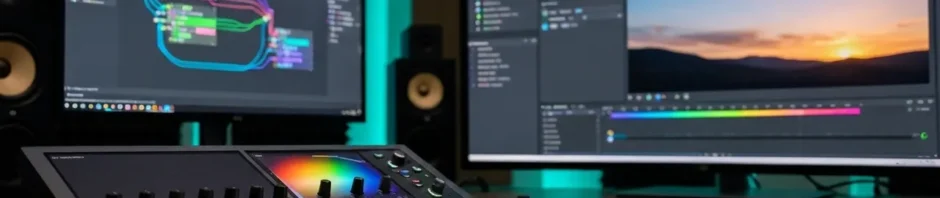
On May 14, 2026, Blackmagic Design signaled a definitive shift in the landscape of creative software with the release of DaVinci Resolve 21 Public Beta 3. While the initial April announcement teased a future where video and photography pipelines finally converged, Beta 3 represents the stabilization of that vision. This update is not merely a collection of incremental patches; it is the formal activation of a “digital arsenal” designed to dismantle the industry’s reliance on high-cost subscription models. By fully integrating the ambitious Photo Page and introducing advanced “Agentic AI” utilities, Blackmagic is positioning its flagship NLE as the singular, high-performance environment for the modern multimedia professional.
The Node-Based Revolution: How DaVinci Resolve 21 Reinvents Photography
The centerpiece of the DaVinci Resolve 21 update is the comprehensive integration of the Photo Page. For decades, photographers have been tethered to layer-based or slider-centric workflows popularized by Adobe Lightroom. Blackmagic has disrupted this hierarchy by bringing the “Hollywood-grade” node-based architecture of its Color Page directly to still images. This approach treats photo editing not as a stack of opaque layers, but as a modular, non-destructive signal path.
In Beta 3, the Photo Page allows for the processing of native RAW formats from Sony, Canon, Fujifilm, and Nikon at their original source resolution—supporting up to 32K or 400-megapixel files. The technical advantage of node-based photo grading lies in its precision. Users can create parallel nodes to isolate specific tonal ranges or serial nodes to build complex stylistic looks without “clobbering” previous adjustments. Furthermore, the LightBox view has been optimized in this release, providing a bird’s-eye overview of entire albums where grades can be compared and batch-applied across hundreds of stills in real-time.
“Modern Ninja” Utility: Sony Alpha 7 V Tethering and Lightroom Migration
One of the most significant upgrades in the Public Beta 3 release is the expanded support for live camera capture, specifically optimized for the newly released Sony Alpha 7 V. This tethering capability transforms DaVinci Resolve 21 into a professional studio hub. Photographers can now control ISO, aperture, and white balance directly from the software, with captured images populating the media pool instantly for immediate grading. This bridge between capture and post-production effectively eliminates the “media ingestion” delay that often plagues high-volume commercial shoots.
To further facilitate the industry’s exodus from subscription-based ecosystems, Blackmagic has introduced a high-fidelity Lightroom Catalog importer. This tool allows users to migrate existing libraries—including metadata, star ratings, and keywords—directly into Resolve’s “Albums.” While specific Lightroom-proprietary sliders are re-interpreted into Resolve’s primary color controls, the transition is remarkably seamless, enabling professionals to keep their legacy work alive within a more powerful, local-processing environment.
Agentic AI Integration: The Neural Engine’s New Frontier
The term “Agentic AI” in DaVinci Resolve 21 refers to tools that do more than just filter; they analyze, understand, and act upon media content with minimal user intervention. Powered by the latest iteration of the DaVinci Neural Engine, Beta 3 stabilizes several transformative AI features:
- IntelliSearch: This is a multi-modal AI content search engine. It allows editors to search for specific objects (e.g., “blue car”), specific people via facial recognition, or even specific spoken phrases across thousands of hours of footage. In Beta 3, the indexing speed has been improved by 30%, making it viable for massive documentary archives.
- CineFocus: Perhaps the most “magical” of the new tools, CineFocus uses AI to map the depth of a 2D scene, allowing users to shift the focal point and adjust the virtual aperture in post-production. It simulates realistic optical bokeh, including customizable “cat-eye” or “onion-ring” lens characteristics, which were previously only possible with expensive anamorphic glass or complex 3D tracking.
- AI Face Age Transformer: Enhancing the existing facial refinement suite, this tool allows for precise “facial de-aging” or aging. Unlike simple smoothing filters, it reshapes facial geometry and skin texture based on learned biological patterns, ensuring that blemish removal and feature reshaper adjustments remain consistent even as the subject moves through varying light.
Motion Graphics and Fusion: The Krokodove Revolution
For motion designers, DaVinci Resolve 21 marks a milestone with the native integration of the Krokodove toolset. Previously a third-party plugin, these 100+ tools are now baked into the Fusion page. Krokodove expands Resolve’s vector capabilities, offering advanced 2D and 3D graphic templates, “Pack” nodes for organic object distribution, and “Fragments” for sophisticated procedural destruction effects. This addition alone significantly reduces the need for external motion graphics software.
Furthermore, the software now offers native support for Lottie animations and OGraf HTML graphics. As digital content increasingly demands high-performance web-ready assets, the ability to drag and drop .json and .lottie files directly into the timeline—where they are treated as fully rendered animation clips—is a massive workflow boon. This allows social media managers and web developers to iterate on graphics without the heavy overhead of traditional video renders.
Privacy-First Performance and Hardware Requirements
In an era of cloud-mandated AI, Blackmagic remains committed to local processing. Every AI feature in DaVinci Resolve 21, from IntelliSearch to CineFocus, runs entirely on the user’s hardware. This ensures that sensitive media never leaves the local environment, providing a layer of security that “Cloud AI” editors cannot match. However, this power comes with specific hardware demands. To leverage the full suite of Agentic AI tools at 4K or higher resolutions, Blackmagic recommends a GPU with at least 16GB of VRAM. Beta 3 includes significant performance optimizations for Windows ARM and Apple Silicon, utilizing the latest NPU (Neural Processing Unit) architectures to offload tasks from the main GPU, thereby maintaining smooth timeline playback even during heavy AI inference.
Refining the Edit: 4-Point Bezier and MultiMaster Trim
The “bug-squashing” phase of Beta 3 has particularly benefited the Cut and Edit pages. The new 4-point Bezier easing for keyframes allows for cinema-quality retiming of clips, giving editors the granular control required for complex “speed ramps” and smooth transitions. Additionally, the MultiMaster trim manager enables a “hero” timeline to generate multiple HDR and SDR deliverables simultaneously. This tool allows the colorist to manage different brightness targets (Nits) within a single project, ensuring that the visual intent remains consistent across Netflix, YouTube, and traditional broadcast standards without the need for separate timelines.
Conclusion: The Ultimate Professional Pivot
The DaVinci Resolve 21 Public Beta 3 release is more than just a software update; it is a declaration of independence for creators. By bridging the gap between high-end cinematography and professional photography, and by infusing both with local, privacy-respecting AI, Blackmagic Design has created a tool that is truly greater than the sum of its parts. For those looking to escape the “subscription trap” while gaining access to Hollywood’s most advanced toolset, the “Digital Arsenal” is finally complete. Whether you are a solo “Modern Ninja” creator or a high-end post-production house, this release represents the most stable and feature-complete entry point into the next generation of creative work.